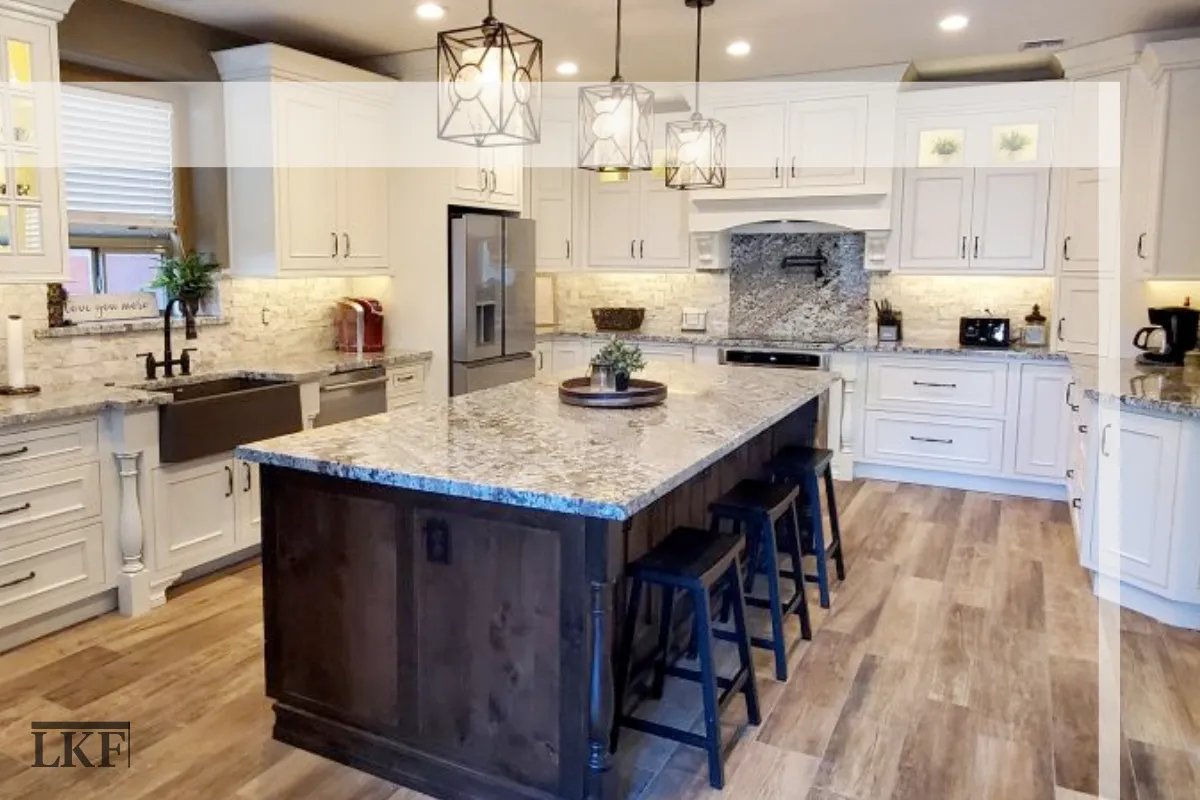
How Should My Kitchen Island Lighting Be? - London
Good lighting can make or break a kitchen island. Get it right and your island becomes the most inviting spot in the house. Get it wrong and you're left squinting over a chopping board or sitting in a pool of harsh overhead glare. Whether you're planning a full kitchen renovation or simply refreshing the space you've got, the lighting decisions you make above your island matter more than most people realise.
Quick take: Pendant lights hung 30–36 inches above the countertop are the most popular choice for kitchen islands. The size and number of pendants you need depends on your island's length, and the style should tie in with the rest of your kitchen's look. This guide covers everything from fixture types and hanging heights to how many pendants your island actually needs, all with London homes in mind.
Table of Contents
Why Lighting over Kitchen Islands Matters
How to Choose the Right Size Fixture
Best Types of Lighting for Kitchen Islands
How High to Hang Lights over a Kitchen Island
How Many Pendants You Need for Your Island
Matching Island Lighting to Your Kitchen Style
Why Lighting over Kitchen Islands Matters
The kitchen island has become the hub of the modern London home. It's where you prep dinner, help the kids with homework, share a glass of wine with friends, and grab breakfast on a busy morning. That kind of all-day use demands lighting that keeps up.
Strategically placed island lights provide bright task illumination for cooking and meal prep, making those jobs more practical. At the same time, they act as a focal point, giving the island a visual presence it wouldn't otherwise have. Good lighting also shows off the island's best features. A beautiful stone worktop, a striking cabinet finish, a carefully chosen tile splash: all of these look their best under well-placed light rather than lost in a dim corner.
There's also the atmosphere side of things. Warm, considered lighting shifts the feel of the kitchen from purely functional to genuinely welcoming. For many London homeowners, the island doubles as a dining and social spot, and lighting sets the tone for that. Bright enough to work in, warm enough to relax in. That's the balance you're aiming for.
If you're fitting a new kitchen or rethinking an existing layout, get in touch with us and we'll help you get the lighting side right from the start.
How to Choose the Right Size Fixture
One of the most common mistakes people make with island lighting is choosing pendants that are either too small or too large for the space. Proportion matters here more than personal taste alone.
A good rule of thumb: each pendant's diameter should be roughly one-third to one-half the width of your island. So if your island is 90 cm wide, you're looking at pendants somewhere between 30 and 45 cm wide. That range keeps things balanced without the lights looking lost or overwhelming.
If you're hanging multiple pendants, the total combined width of all the fixtures should stay under the island's full length. That keeps spacing even and stops things looking cluttered.
Ceiling height also plays into this. London homes vary a lot here. Victorian terraces, period conversions, and new-build flats all come with different ceiling heights, and that affects what scale of fixture works. Rooms with high ceilings can carry a grand statement pendant or chandelier without it feeling out of place. Lower ceilings call for something more streamlined. A quick tip: cut a paper template to your intended pendant's size and hold it above the island before you buy. It sounds simple, but it genuinely helps you picture how a fixture will feel in your specific kitchen.
Best Types of Lighting for Kitchen Islands
There's no single right answer here. The best type of lighting depends on your island's size, your ceiling height, and the overall style of your kitchen. Here's a breakdown of the main options.
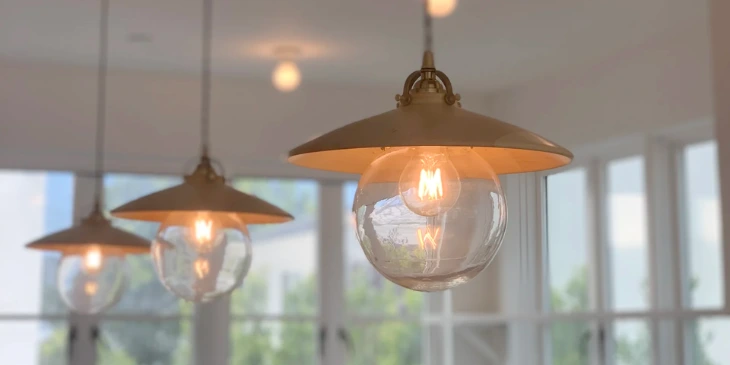
Pendant lights are the most popular choice for kitchen islands, and it's easy to see why. They come in an enormous range of styles, from simple glass globes to industrial metal shades, and they do two jobs at once: task lighting for the worktop below, and decorative interest at eye level. You can hang a single bold pendant over a smaller island or a row of pendants over a longer one. Clear or open-frame designs keep things feeling airy; drum or dome shades push more light downward for focused task work.
Chandeliers are a strong option when you want a real statement above the island. They work well in open plan kitchens where the space can carry a larger fixture. Modern linear chandeliers designed specifically for islands are well worth considering: they cover the full length of the island from a single fitting, which makes installation tidier.
Track lighting suits larger or unusually shaped islands particularly well. The individual heads can be angled to cover different areas of the worktop, which gives you useful flexibility. It works best in contemporary and industrial-style kitchens, and lends itself to higher ceilings where pendant options might feel cramped.
Recessed lighting is the most unobtrusive option. Flush with the ceiling, it keeps sightlines completely open and suits a clean, minimalist look. The trade-off is that it lacks the decorative presence of pendants or a chandelier. Many London homeowners use recessed ceiling lights as a base layer of ambient light across the whole kitchen, then add a pendant or two above the island for warmth and character. That combination tends to give the best results in a busy kitchen.
How High to Hang Lights over a Kitchen Island
Hanging height is one of those details that's easy to get wrong and frustrating to fix once the wiring is in. The standard guidance is to hang the bottom of your pendant 75–90 cm above the island countertop. That range keeps the light low enough to properly illuminate the work surface, but high enough that nobody bobs their head when they stand at the island.
London homes don't always have standard ceiling heights, so it's worth adjusting for what you've got. If your kitchen has ceilings higher than 2.4 m, add roughly 5–8 cm of extra hanging height for each additional 30 cm of ceiling above that. That keeps the lights looking proportional rather than floating too far from the worktop.
On the lower end, always make sure there's at least 2.1 m of clearance from the floor to the bottom of the fixture. That protects taller family members from any uncomfortable encounters with a pendant.
If your household includes particularly tall people, err toward the higher end of the 75–90 cm range and adjust during installation. Most pendant lights come with adjustable rods or chains, which makes fine-tuning the height straightforward once you can see the fixture in position.
How Many Pendants You Need for Your Island
The number of pendants you need depends primarily on how long your island is and how large each pendant is. As a starting point, here are some practical guidelines by island length.
For islands around 1.2–1.5 m long, two pendants are usually enough to cover the surface evenly. A smaller island might only need one centred pendant, particularly if it's a larger, bolder fixture.
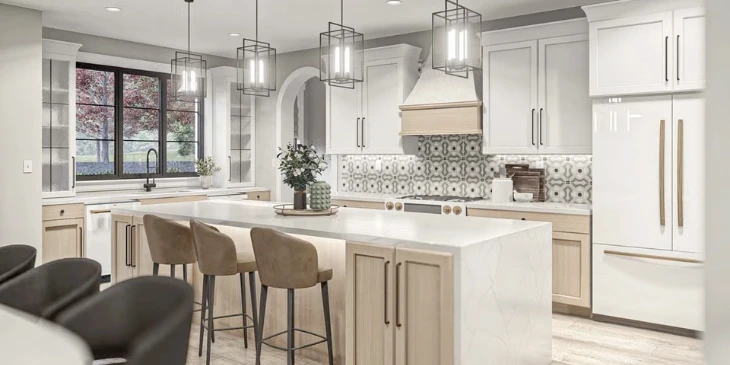
Islands in the 1.8–2.4 m range generally work well with two to three pendants. Two larger pendants or three medium ones, evenly spaced, give good coverage and a clean, symmetrical look.
Longer islands of 2.7 m and above typically need three to five pendants depending on the size of each fixture. Very long islands can also work well with a single linear chandelier designed for island use, which avoids the visual complexity of five separate pendants in a row.
Spacing between pendants matters as much as the quantity. Aim for roughly 60–75 cm between the centre of each pendant. Leave at least 15–30 cm from the edge of the island to the nearest pendant on either end, so the fixtures don't look like they're about to fall off the sides.
Matching Island Lighting to Your Kitchen Style
The best island lighting doesn't just illuminate the space. It feels like it belongs there. Choosing a fixture that clashes with your kitchen's overall style can unsettle an otherwise well-designed room. Here's how to match your lighting to the three most common kitchen styles we work with across London.
Modern and contemporary kitchens call for clean lines and minimal decoration. Polished chrome, brushed nickel, and matte black all work well here. Simple globe pendants or slender linear bars sit naturally in a modern kitchen without drawing attention away from the wider design. If your kitchen leans industrial, exposed Edison bulb pendants or metal dome shades in black or copper add character without overcomplicating things.
Traditional kitchens suit classic, timeless fixture designs. Think lantern-style pendants with clear glass panels, small chandeliers with warm metalwork, or lights with fabric shades in antique brass or bronze. A pair of wrought-iron lanterns or small crystal pendants above a traditional island adds warmth and period detail without feeling forced. We fit a lot of Howdens, Wren, and IKEA kitchens across north London, south London, east London, and west London, and traditional styles remain consistently popular in period properties across all four areas.
Rustic and farmhouse kitchens work best with warm, textured materials. Barn-style pendants, weathered metal finishes like oil-rubbed bronze or galvanised steel, and fixtures with wooden details all fit this aesthetic well. Edison bulb cage pendants or a wooden linear chandelier above the island give a relaxed, characterful focal point. Make sure the finish ties in with your cabinet handles and tap, as that's what pulls a rustic scheme together.
Many London kitchens blend styles rather than committing fully to one. In those cases, look for fixtures that bridge the gap: a drum pendant with a simple shape but a warm brass finish, or an updated lantern that feels classic without being heavy. The goal is for the lighting to feel like a natural part of the room rather than an afterthought.
If you're still working out what style is right for you, our about page gives a sense of who we are and how we approach the design process. We also work with B&Q kitchen ranges for those looking for more accessible options.
Final Thoughts on Lighting over Kitchen Islands
Island lighting is one of those decisions that touches both the practical and personal sides of your kitchen. The right fixtures make the space easier to cook in, more inviting to gather in, and genuinely more beautiful to look at.
The key things to get right: choose pendants proportional to your island's width, hang them at the correct height, space them evenly along the island's length, and make sure the style ties in with the rest of your kitchen. None of this needs to be complicated. Take the measurements, consider the ceiling height you're working with, and pick a fixture style that feels honest to your kitchen rather than forcing something in that doesn't belong.
If you're planning a kitchen with an island and want help getting the lighting, layout, and fitting right from the start, London Kitchen Fitting is here for the whole project.
Lighting over Kitchen Islands FAQs
How high should kitchen island lights hang?
The bottom of your pendant should sit roughly 75–90 cm above the island countertop. That height gives good task illumination without blocking sightlines or putting the light in anyone's eyeline when they're standing at the island. If your kitchen has higher-than-average ceilings, add a little extra height to keep the fixture looking proportional. Most pendants come with adjustable rods or chains, so you can fine-tune this once the fitting is in place.
How many pendant lights do I need over my kitchen island?
It depends on the island's length and the size of your chosen pendants. A 1.2–1.5 m island usually works with one or two pendants. Islands of 1.8–2.4 m suit two or three. Longer islands of 2.7 m and above typically need three or more, or a single linear chandelier. The aim is to cover the full countertop without leaving dark spots or crowding the space.
What size should pendant lights be over a kitchen island?
Each pendant's diameter should be roughly one-third to one-half the width of your island. If you're hanging multiple pendants, the combined total width of all fixtures should stay under the island's full length. Transparent or glass pendants can be physically larger without looking heavy; solid metal shades of the same size will feel more substantial in the space.
What type of light bulb is best for kitchen island lighting?
LED bulbs are the practical choice. They're energy-efficient, long-lasting, and come in a range of colour temperatures, so you can go cooler and brighter for task work or warmer for a relaxed atmosphere. LED Edison-style bulbs are worth considering if you want the warmth of a filament look without the energy cost of traditional incandescents. It's also worth fitting a dimmer switch if your kitchen does double duty as a social space.
Can I use a chandelier over a kitchen island instead of pendants?
Yes, and it can look brilliant. A linear chandelier designed specifically for kitchen islands is a particularly good option: one fitting, multiple bulbs, and a clean installation. Follow the same sizing and height rules as you would for pendants. Matching the chandelier's finish to your cabinet hardware or tap is a simple way to make it feel considered rather than just dropped in.
