How Should I Store My Knives In My Kitchen? - London
Most London kitchens are short on space, long on knives, and somewhere in the middle sits a drawer that nobody quite wants to reach into. If your knives are rattling around loose, it's worth knowing that it's not just your blades that take the hit. It's your fingers too. Good knife storage protects both.
Quick take: Knife storage matters for safety and blade longevity. Your best options are magnetic strips, knife blocks, drawer inserts, or under-cabinet mounts. Which one suits you depends on your kitchen layout, your knife collection, and who else uses the kitchen. This guide covers all of it, with practical advice tailored to London homes.
Table of Contents
Why Proper Knife Storage Matters
Common Knife Storage Options for Modern Kitchens
How to Choose the Best Knife Storage for Your Space
Knife Storage Safety Tips for Busy Households
Smart Knife Storage Ideas for Small and Fitted Kitchens
Why Proper Knife Storage Matters
Tossing knives loosely into a drawer is one of the most common kitchen habits, and one of the most damaging. Blades knocking against each other dull far faster than any cutting board ever would. Worse, reaching into a crowded drawer blind is a reliable way to grab the wrong end of a knife.
Good knife storage does the opposite. It keeps each blade isolated, so it only ever meets food and a cutting surface. As knife experts note, knives kept in a proper home stay sharper for longer, which means less time at the whetstone and more time actually cooking. For busy households across London, that's a practical win.
It also makes cooking more pleasant day to day. When knives are stored well, they're quick to grab, easy to identify, and ready to use. When they're not, every meal prep starts with a small hazard.
Common Knife Storage Options for Modern Kitchens
There's no single right answer here. The best knife storage for your kitchen depends on your space, your habits, and your knives. Here's a rundown of the most common options and what each one actually offers.
Wall-Mounted Magnetic Strips
A magnetic strip fixed to a wall or splashback holds knives by their spine, keeping blades visible and easy to grab without taking up any counter or drawer space. They're simple to wipe clean, and a quality strip with strong neodymium magnets holds knives firmly without letting them slip. If you're fitting a new kitchen in London, a magnetic strip built into the splashback design is a clean, practical touch. Just make sure it's mounted well out of children's reach.
Freestanding Magnetic Blocks
These sit on the counter and hold knives on the exterior face of the block rather than inside slots. That means the cutting edge never rubs against anything, which is better for blade longevity. Slim two-sided models can hold a full knife set without taking up much room, useful in tighter London kitchens where every inch of worktop counts.
Traditional Slotted Knife Blocks
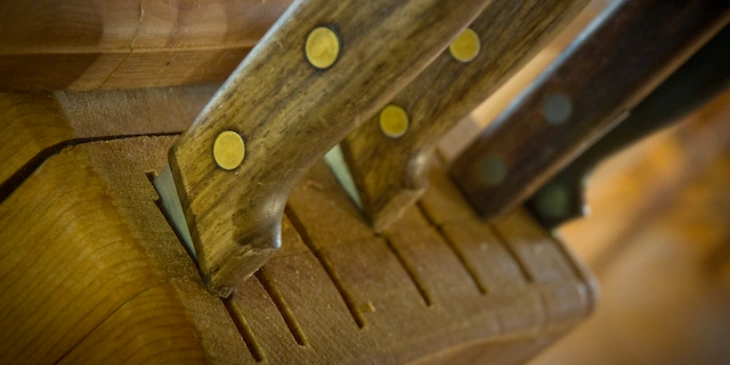
The classic choice. Slotted wood or bamboo blocks keep knives covered, organised, and off the counter in a familiar way. The downsides are real though: slots are difficult to clean, trap moisture and food particles, and can harbour bacteria if neglected. They also have fixed slots, so if your knives don't match the block's sizing, you'll end up with gaps or knives that don't fit at all.
In-Drawer Organiser Inserts
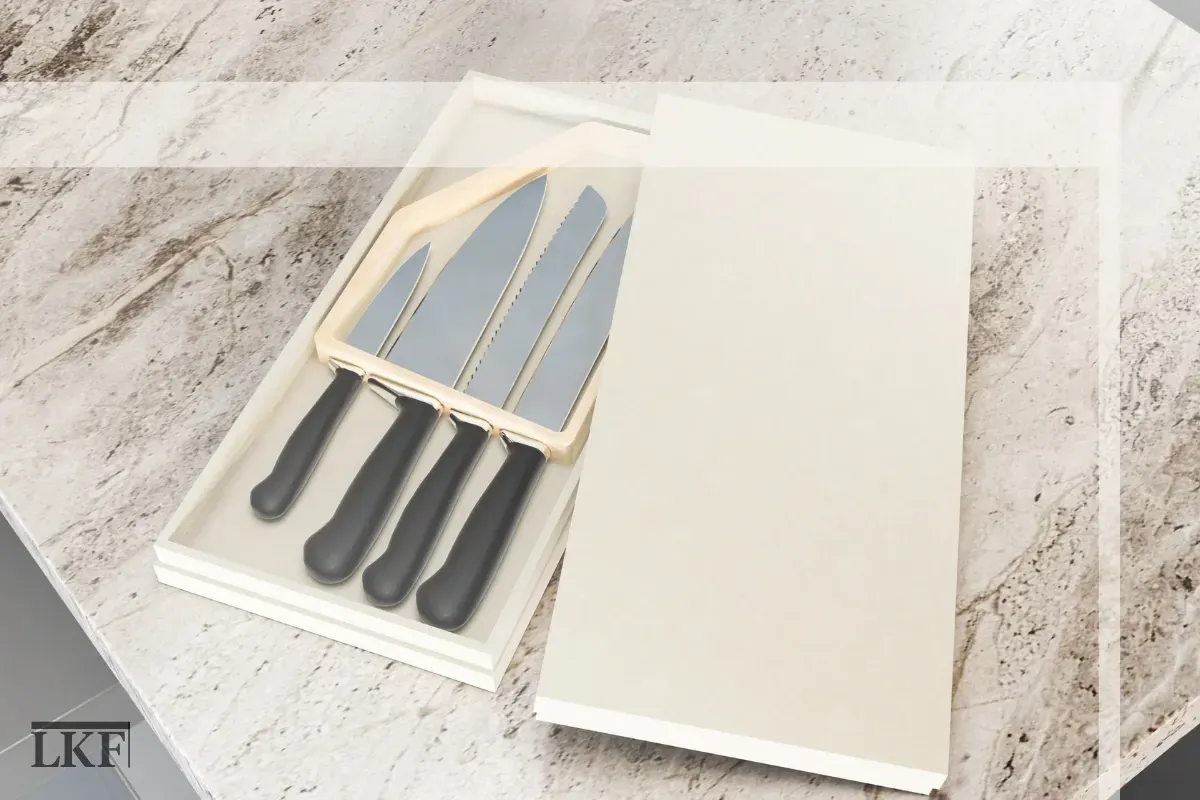
A fitted drawer insert lets knives lie flat, blade-down in separate slots, handles facing up for safe removal. It keeps everything out of sight, which some people prefer, and protects edges better than loose storage. The trade-off is that knives are less visible during prep and the insert takes up a full drawer. High-quality versions use wood or soft liners to cushion blades properly.
Knife Guards and Sheaths
Plastic or nylon blade covers slide over individual knives and protect the edge when knives are stored in a drawer or being transported. They're not the most convenient for daily use, as each one has to come on and off every time, but they work well as a supplement when other storage options aren't available.
How to Choose the Best Knife Storage for Your Space
Choosing the right knife storage is about matching the solution to your kitchen, not just picking whatever looks good in a photo.
Space and layout first. If your worktop space is already tight, common in many south London flats and terraced houses, go vertical. A wall-mounted magnetic strip or an under-cabinet block uses wall space instead of the counter. If you have deep drawers and want a clean worktop, a drawer insert could be the better fit.
Think about your knife collection. Magnetic strips and blocks accommodate all shapes and sizes without fixed slots, making them a better choice if you have a varied or growing collection. If you've got a matching set from Howdens or Wren, a traditional slotted block might work just fine, as long as every blade fits properly.
Factor in who uses the kitchen. Households with young children need to think carefully about accessibility. High-mounted strips, locked drawers, or blocks placed well above counter level all reduce risk. In east London and west London homes where multi-generational living is common, this is worth planning into the kitchen design from the start.
Consider hygiene. Metal strips and sealed wooden blocks wipe down easily. Porous wood slot blocks need more attention: moisture and debris collect in the slots and can lead to bacterial build-up if the block isn't cleaned regularly. If hygiene is a priority, a magnetic option is generally the more practical choice.
Your personal preferences count too. Some people love the look of knives displayed on a wall strip. Others prefer everything hidden away. If you're renting and can't drill into walls, a countertop block or a strong adhesive strip avoids that problem entirely. Whichever you choose, it should work with how you actually cook, not just how you'd like your kitchen to look.
Knife Storage Safety Tips for Busy Households
For families with children or anyone moving quickly around the kitchen, knife storage isn't just an organisational question. It's a safety one.
Keep knives out of reach. Store sharp knives in secure holders or drawers rather than on low countertops. Childproof latches on knife drawers are a straightforward addition and well worth fitting. As the UK Health and Safety Executive advises, knives should always be stored in a sheath, block, or container after use. Never leave them loose on surfaces or in sinks.
Never leave knives unattended. Even for a few minutes. A knife left on a worktop or soaking in a washing-up bowl is a hazard waiting to happen. Rinse, dry, and return knives to storage straight after use. It sounds simple because it is, but it's the step most people skip.
Use guards or inserts in drawers. If counter or wall space genuinely isn't available and knives have to go in a drawer, use a properly fitted insert or individual sheaths. This prevents anyone rummaging in the drawer from catching a blade. A wall strip is widely recommended for households with children because it keeps knives fully visible and well out of reach when mounted at the right height.
Talk to your household. Everyone who uses the kitchen should know where knives live and how to handle them safely. That includes older children who are starting to help with cooking. A consistent routine, always by the handle, always returned to the same place, takes seconds to build and prevents accidents.
Check your storage regularly. A magnetic strip with weakening magnets, a warped block, or a poorly fixed wall mount can all fail unexpectedly. It's worth checking every few months that everything is still secure and doing its job properly.
Smart Knife Storage Ideas for Small and Fitted Kitchens
Space is at a premium in most London homes, and knife storage is one area where a bit of creative thinking goes a long way.
Under-cabinet knife blocks mount beneath your upper cabinets, keeping knives within arm's reach without touching the worktop at all. If you're having a new kitchen fitted in north London or anywhere else across the city, it's worth asking your fitter to factor this in from the outset.
Magnetic strips on walls or inside cabinet doors are one of the most space-efficient options available. A strip on a side wall next to the hob, or on the inside of a larder door, keeps the worktop completely clear. Some homeowners use two strips stacked or placed end to end to increase capacity without expanding the footprint. For small kitchens in particular, this approach is hard to beat.
Slim two-sided magnetic blocks offer double the capacity in a narrow profile, some are under three inches wide, and fit neatly into corners or against a splashback without getting in the way.
Modular drawer inserts designed for narrower drawers are another option if wall or counter space is genuinely not available. Some use cork or soft liners to protect blade edges and can be extended as your knife collection grows.
The wider principle is the same whether you're working with a compact galley kitchen or a larger fitted kitchen: use every available surface. Walls, the undersides of cabinets, the backs of door fronts. A good kitchen fitter will know how to make the most of all of it.
Final Thoughts on Knife Storage
Good knife storage is one of those small details that makes a real difference to how a kitchen feels and functions day to day. It keeps your knives sharper for longer, makes cooking safer, and removes one of those minor daily frustrations that quietly add up over time.
Whether you go for a wall-mounted strip, a countertop block, or a fitted drawer insert, the key is choosing something that actually fits your kitchen and your routine. Keep blades clean and dry before storing them, keep them out of reach of children, and check that whatever you're using is securely fixed.
If you're planning a new kitchen and want storage solutions built in properly from the start, the team at London Kitchen Fitting are here to help. We work across north, south, east, and west London, and we handle everything from design to fitting. Get in touch or find out more about us to get started.
Knife Storage FAQs
How often should I clean a knife block or storage rack?
About once a month is the right interval for a knife block. Remove all knives, clear out any debris with a small brush or vacuum, wipe the exterior with soapy water, and scrub each slot thoroughly. Let it dry completely before putting the knives back. Magnetic strips are much easier to maintain: a regular wipe-down with a damp cloth is all they need.
Is it safe to store knives in a drawer?
Yes, provided you use a fitted drawer insert, knife roll, or individual sheaths. Each blade needs to be properly covered so that anyone reaching into the drawer can't catch the edge. Never put loose knives in a drawer, and never leave them rattling around with other utensils.
Are magnetic knife strips safe for knives and people?
High-quality magnetic strips using neodymium magnets are very safe. They hold knives firmly without dulling the blade, since there are no slots for the edge to drag through. They do need to be properly fixed to the wall: a poorly installed strip is a hazard. If children are in the home, mount the strip well above counter height.
Are wooden knife blocks hygienic?
They can be, but they need regular cleaning. Moisture and food particles collect in the slots and can encourage mould if the block is neglected. If hygiene is a concern, a block with removable liners or a magnetic holder is a more practical option for London households that use the kitchen heavily.
Should knives be completely dry before storing?
Absolutely. Any moisture left on a blade, even on stainless steel, will speed up rust and bacterial growth. Always dry knives thoroughly after washing before returning them to storage.
Is it OK to put knives in the dishwasher?
No. Even knives labelled as dishwasher-safe take a beating from the heat and detergent. It dulls blades and damages handles over time. Wash knives by hand, dry them straight away, and put them back in their proper place. Brands like IKEA and B&Q often include care guidance with their knife sets, and it's worth following it.
